


What Clinicians Actually Do in Product, and When Clinical Input Changes the Build with Caitlyn Tivy, PT, DPT
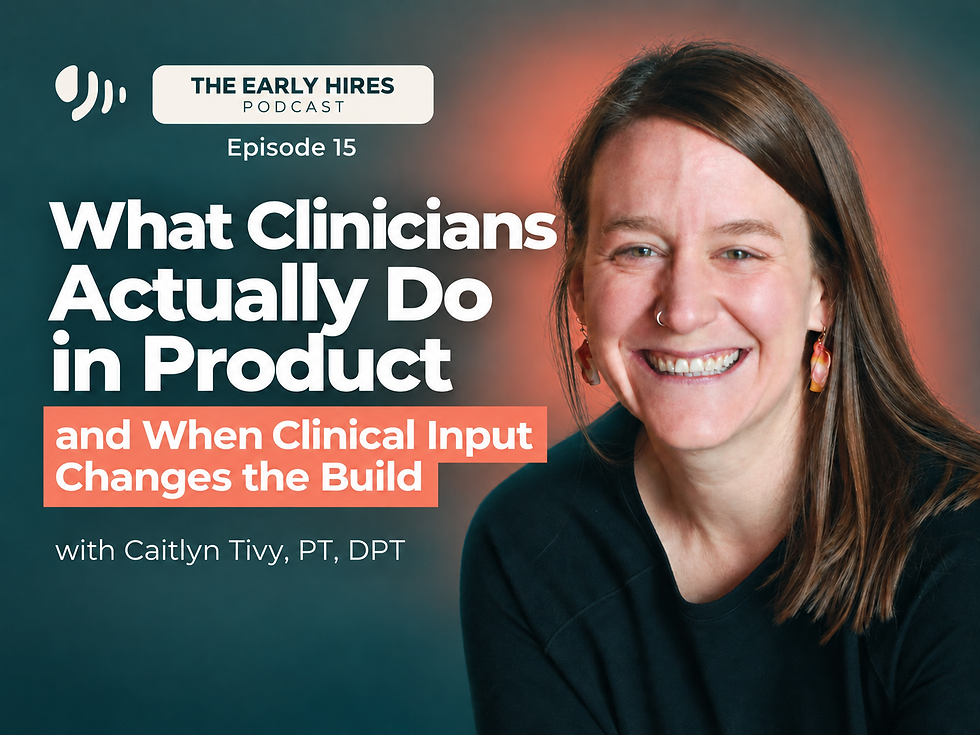
What Clinicians Actually Do in Product, and When Clinical Input Changes the Build with Caitlyn Tivy, PT, DPT
Product is where a lot of clinicians land once they are inside a healthcare startup, and almost nobody explains what the job actually is. In this episode, host Helen Tanner talks with Caitlyn Tivy, PT, DPT, a pelvic and women's health physical therapist who took a startup role during the pandemic, practiced telehealth inside it, and then got pulled onto the team building a brand new product line because she was one of the few pelvic-trained clinicians in the company.
Now three years into her own consultancy, Caitlyn works as a fractional clinical leader inside several health tech companies at once, which gives her a rare view across the ecosystem: when clinical input gets brought in, what changes when it does, and what gets built badly when it does not.
Helen and Caitlyn take product apart: the difference between biotech, medtech, and health tech, the line between a regulated product and a wellness product, what a week looks like when you are managing medical advisors and working with designers in the same afternoon, and how one advisor's offhand comment became a feature that was never on the roadmap. Caitlyn is direct about the friction too: why clinicians get labeled slow, how to tell safety caution apart from logistical delay, and why clinical advisors should be paid for their expertise.
For any clinician who can feel themselves being pulled from care delivery toward the build, this is the plainspoken version of what waits on the other side.
Must-Hear Insights and Key Moments
Know which world you are in. Biotech sits closer to the lab and pharmaceuticals. Medtech usually means devices, implants, or hardware inside a clinical workflow. Health tech is mostly apps, programs, and platforms, and many companies start out as wellness products rather than regulated ones. That line governs every claim the product can make.
"Product" is a range of jobs, not one job. It can mean reviewing educational content for claims that read as medical advice, checking content against current evidence, managing a medical advisory team, working with designers on how the product looks and feels, and a lot of project management.
The translator seat is the job. Caitlyn sits between the medical advisors and the engineers, designers, and project managers. Her value is that she can carry a clinical concern to the build team in a form they can act on, and carry the deadline back the other way.
Safety first, then flex. Patient and user safety always comes first. Beyond that floor, ask where you can be flexible so the team does not fall behind. Helen adds the check every clinician should run: is this step truly the safest evidence based approach, or is it just the protocol we have always used?
Clinical input early finds what the build was missing. During a review of an unrelated part of an app, a medical advisor noted that patients often come to prenatal visits not knowing what to ask. That comment became a prototype, then a line by line review by each specialty, then a shipped feature that was never on the original roadmap.
Slow for safety is the job. Slow for logistics is a different problem. Advisors get labeled slow, but much of the delay comes from companies expecting clinical advisors to work for free. Unpaid advisors are volunteering their time, and response times reflect it.
Your advice does not always show up where you can see it. Advisors often never learn which of their recommendations made it into the product. If you manage advisors, close the loop and show them.
Three things that drive success in product roles: see both sides and find solutions that work for the clinical and non-clinical team, keep upskilling (project management, AI prompting, short courses) the same way you approach continuing education, and get curious about the business side instead of treating it as "icky."
Key Questions Helen Asks Caitlyn
What does "product work" actually mean for a clinician? It usually means helping build a digital solution, often an app, online program, or telehealth platform, from the ground up. Caitlyn's first projects included reviewing content for overreaching claims, accuracy, and alignment with current evidence.
What does a day to day look like in product? As a fractional head of clinical affairs, Caitlyn manages a medical advisory team with weekly tasks, brings in specialty consultants, communicates advisor findings to engineers and designers, and makes sure content comes from reliable, advisor approved sources. It is very "project manager-y."
How do you translate clinical reasoning into something a team can build? Keep both perspectives in mind. Understand that the engineers are being pushed to ship by a deadline, protect safety, and flex where you can. Much of the translation skill comes from practice and from learning the tools (Figma, Slack, Notion) by using them.
Why did she start her own consultancy? After working inside a startup full time, Caitlyn realized a smaller scale fit her better. Since she was going to work hard either way, she chose to do it for herself, with the flexibility to set her own structure and hold to her own values.
How has being a clinician shaped the way she operates in a startup, and vice versa? Her clinical and ethical standards keep her steady in a fast moving world, and startups have taught her to be more flexible in how problems get solved, without sacrificing those standards.
Words of Wisdom: Standout Quotes from This Episode
“ I speak both medicalese and startupese, and I can translate between the two languages.” - Caitlyn Tivy
“For me, patient or user safety still always comes first, but where can we be flexible to push something along a bit?” - Caitlyn Tivy
“Is that truly the evidence-based way that the patient is the safest? Or is it just the protocol that we've always used?” - Helen Tanner
“You wouldn't expect an engineer to code for you for free. Why would you expect a healthcare provider to give all their advice and their hard-earned knowledge for free?" - Caitlyn Tivy
“Startups have also taught me how to be flexible in my thinking without sacrificing my morals.” - Caitlyn Tivy
About Caitlyn Tivy, PT, DPT
Caitlyn Tivy is a Doctor of Physical Therapy trained in pelvic and women's health, with an orthopedic residency and years of clinical practice before moving into the startup world. Since founding C Tivy Consulting in 2023, she has served as a fractional clinical leader for women's health and femtech companies across the ecosystem. Current and former clients include Amissa Health, Cervu Health, ProMom, Lasa Health, and Peli Health, and she provides medical writing, editing, and content management for women's and queer health clients including Origin, Mira, and Evvy. She believes that with the right perspective and experience, clinical leaders can become a health startup's strongest asset, and that they can even learn to play nicely with engineers. She is also co-host of the upcoming podcast That's Gynomite!
Mentioned in the episode:
In Women's Health (formerly FemHealth Insights), founded by Jodi Neuhauser: a community and job board for people working in women's health
Health Tech Nerds: a broader health tech community
TechSpeak for Entrepreneurs: AI Agents course with Nelly Yusupova
LinkedIn Learning: where Caitlyn taught herself project management
Figma: the design tool clinicians in product learn by using
Get the Free Field Guide
Get The Early Hires Clinician Startup Field Guide: 10 Things Every Clinician Should Know Before and After Joining a Startup. Sign up at www.theearlyhires.com, and the guide comes straight to your inbox. You will also be signed up for The Early Hires monthly newsletter.
Follow The Early Hires
Follow Helen Tanner
Get The Early Hires Monthly Newsletter
Are you a clinician navigating startup life? Sign up at www.theearlyhires.com for monthly insights, updates, and best practices for leading inside healthcare startups.
Episode Transcript:
Note: We use AI transcription so there may be some inaccuracies
Helen Tanner: Welcome to The Early Hires, the podcast for clinicians and startups. I'm your host, Helen Tanner. This is a show for early clinical operators working alongside founders to build the next generation of healthcare companies. Every episode is designed to help you feel more understood in your role, clearer about your influence, and more confident in how you show up inside a growing company. If you're a clinician working inside a startup, The Early Hires is for you.
Hi, I'm Helen, your host of the Early Hires, and today we are talking product. Product is where a lot of clinicians land once they're inside a startup, and it can mean a lot of different jobs. Research, validation, clinical review, it's being in the person in the room with the engineers, the designers. So today we're going to talk about what product work actually is, the different forms it takes, how a clinician turns what they know about a body into something a team can build, and what's seen now from the outside across a lot of companies at once. My guest today is Caitlyn Tivy. She's a physical therapist trained in pelvic and women's health. And since founding her consultancy in 2023, Caitlyn has served as a fractional clinical leader for women's health and femtech companies across the ecosystem. Current and former clients include Amissa Health, Cervu Health, ProMom, Lasa Health, and Peli Health, and she also provides medical writing, editing, and content management for women's and queer health clients, including Origin, Mira, and Evvy. She believes that with the right perspective and experience, clinical leaders can become a health startup's strongest asset, and that they can even learn to play nicely with engineers. Important. Very. I'm so glad she's here to share this all. Welcome, Caitlyn.
Caitlyn Tivy: Thanks so much for having me, Helen. Excited to be here.
Helen Tanner: Just before we get into the product work, why don't you tell us the short version of what your clinical career looked like before startups and what drew you into the pelvic and women's health area specifically?
Caitlyn Tivy: Totally. As you mentioned, I'm a doctor of physical therapy. That wasn't my first career. I started in biomedical research after my undergrad. Realized that a life in the lab, while it was fascinating, probably wasn't the right fit for me. and then pivoted into clinical care because it was a nice juxtaposition or intersection of my science nerdiness and my interest in health and working with human beings. And that's sort of how I ended up in physical therapy. I have a long personal history of loving movement and finding movement and activity to be great medicine. So it felt like a natural fit. I did not know that pelvic health physical therapy was a thing when I started my graduate program, like many people, though it is becoming a lot more popular, I'll have to say, in the last decade or so. I learned about it through a close friend in my graduate program. And I was like, oh, this is really interesting. I've always been very interested in how the female body is different from the male body and how we approach that in medicine or probably more appropriately don't always approach it as we should, differently. So when I learned about pelvic health, obviously it applies to people of all genders, but there's a big component of it that focuses on people with vaginas and people with ovaries. So I took a course in graduate school. They let you take one introductory course as a student to see if you like it. And I loved it and ended up specializing in that alongside orthopedics. Orthopedics and pelvic health kind of go hand in hand in the rehab world. I completed a residency in orthopedics and then transitioned into clinical care full-time for about three and a half years before moving into the startup world.
Helen Tanner: So how did you first start working with women's health startups? Did they find you? Did you find them? How did that come to play?
Caitlyn Tivy: Yeah, interesting kind of backstory to that. So during the pandemic, the clinic that I was working in full time, we stayed open. I'm in a rural area of Colorado, so we were considered like a safety net almost to keep people out of their primary care office. That probably contributed to some extent, but I was definitely experiencing a lot of burnout on the clinical end. In the spring of 21, I sort of just fell into a role that I'd forgotten I'd even applied for with a pretty large musculoskeletal startup. Some of your listeners might have heard of Sword Health. And I got a role working with them as they were hiring physical therapists at the time to help with onboarding users into their experience. And I figured, I'll give this a try. Like I have no idea what to expect. I've never worked in the startup world before. I'll try it out. And it was a huge learning curve. Even just practicing as a clinician within a startup is very different than practicing in person. This was a telehealth model using a lot of AI enablement and other technology to facilitate that. While I was there, about the second year, another pelvic physical therapist who was with the company was recruited to build out the women's health side, this new vertical that they were creating. And this was using an intravaginal sensor at the time to facilitate rehab virtually, entirely telehealth. And she reached out to me to see if I'd be interested in contributing some pieces to that process because there was only a handful of us in the company that were pelvic health trained. So I ended up working with her quite closely as we were building out this women's health arm. I did a lot of writing, like a lot of content writing to educate users about what is your pelvic floor? How do you engage it? How do you release it? Why is it important? Et cetera. Really, really enjoyed that. I was there for two years and that whole experience really showed me both the opportunity in this women's health focused ecosystem that I hadn't even realized was there, as well as some of the challenges that the kind of nascent women's health startup space was facing at the time and still is.
Helen Tanner: So you started in a startup practicing clinically at startup and then naturally kind of got pulled in to the product side. Yep. Can you help us understand for those of us who are more care delivery focused, you know, for the startups, But there's a lot of people, you know, clinicians and product. But what is product work actually mean? You know, when you were saying, oh, I work in product or this clinician works in product. What does that mean? What kind of jobs does that entail?
Caitlyn Tivy: Totally. I'm a big believer, as I'm sure you probably are, too, of simplifying things as much as possible when I'm talking to patients. Right. And not assuming they know any medical terms. So I'll do the same thing here. I'm talking about the startup language because I remember stepping into these roles and being like, what the heck is Slack? What is a standup meeting? Like what any of these things mean, right? Because they're just so foreign to those of us who've only been in clinical care or other fields that aren't set up the way the startup and virtual ecosystem is. I should caveat this by saying that my experiences are mostly focused in the health tech world I don't know how much on the podcast you talk about med tech versus health tech and kind of those distinctions at all.
Helen Tanner: Haven't gotten into that episode yet, but please start us off because that's really important. It is really divided in this and you can just, as you know, things can get broken down, broken down. You know, all the different types, so please do.
Caitlyn Tivy: Totally. It is kind of a rat's nest sometimes. And the definitions are changing all the time too, as regulations change and things like that. I think the simplest way to break it down is usually if someone's talking, you'll hear biotech, medtech, and health tech a lot. And there's other categories too, but within the medical technology ecosystem, these are kind of the common ones. Biotech, I find, is often talking about wet lab associated things. People developing novel injectables or medication therapeutics. They're often kind of adjacent to pharmacy or pharmaceuticals. Medtech, think a little bit more medical device-ish or surgical implants or physical hardware usually. Not always, but usually that gets integrated into a medical workflow of some kind. Health tech is kind of its own little category that falls mostly in the what we would call wellness sphere and there's this could be a whole episode I'm sure of this tension between are you a regulated FDA certified registered product or are you a wellness only product and that's a whole another can of worms. But a lot of the companies in the health tech space are starting off as wellness products, meaning they're putting all these disclaimers and saying, we aren't medical advice. We're not a replacement for your primary care and your other clinicians. We are supplementing that with work to help improve your overall health, whether it's musculoskeletal health or heart health or gynecologic health, what have you. So that's kind of like the distinctions as I think of them. That's so helpful. So a lot of my work has been on that ladder, this sort of wellness slash medical world. And it's because of those distinctions, there's a lot of careful lines we have to walk to make sure that we're not leaning too far into claiming medical treatment or medical advice, et cetera. In terms of product, what does that mean? In the health tech world, that can be very confusing because a lot of these things that we're putting out there are digital. They're not physical hardware. It's not a medical device or something you implant. Sometimes it is, but many times it's an app or an online program or a telehealth platform that integrates with an app or sensors or what have you. So it can feel a little nebulous to those of us that are used to having concrete things to hold in our hands. And being in product can mean a lot of different things. And I've also worked in other roles outside of product as well. But I think the easiest way to think of it for someone that's brand new to this world is you're helping to build whatever this digital solution, this digital output is from the ground up, hopefully. There was a pattern, especially when I was first getting into this, of not necessarily bringing in clinical input very early or sometimes at all, which is kind of scary. But that is changing a lot and a lot more startups are wanting to bring in clinicians early on to make sure that we build this thing right and we don't have to go back and fix our work later. So to give a concrete example, Peli Health was a very simple example, and they have since actually closed their doors pretty recently, unable to find a product market fit, which is really sad to see, but that is the nature of startups, as you know, is a lot of them don't continue, or many of them get bought or merge into other companies. But Peli Health was making an educational platform around pelvic health, so very specific to my world. And what I did with them early on was go in and review all of the educational content they had created, which they were hosting in a basically online community. They were integrating it a little bit into mobile, though it wasn't a true app per se. It was more of a login community. And I just went through and did a really brief overview for them of, are you claiming anything that's too big of a claim, that you're accidentally saying something that could be construed as medical advice? And is there anything here in this content that's incorrect? Is there anything that's not up to date with the most recent evidence in pelvic health rehabilitation? And then, of course, from the practical side, are there any other tips that I would add from my experience as well as from the research? I was looking into the literature too. So there was a lot of moving pieces to it, but that was one really small project where I could step in and help them check the box and make sure the baseline information we have here is safe. We're not claiming anything we shouldn't be, and it's accurate. And that helped build their online learning community, their little ecosystem.
Helen Tanner: That is a really good example. Actually, one of my questions was, where does clinical input come into the process? And let's say true, because there has been some challenges with bringing clinicians on early because there is this, right, that how helpful can a clinician really be? Will we slow the process? So brought in as advisors, closer to the end, or like you said, if at all. And so it is nice to see. I feel like we are seeing a really big push of clinicians are being hired on the team. And yes, there are still advisors and there's still consultants coming in to play various roles, as I'm sure, obviously, you're going to talk about that can play various roles at various times. Totally. And that's a great example to see how how you are brought in to basically advise, but then come on to that team and really help build the product. I'm curious, you know, for a clinician who thinks product might be for them, I will say most of the people in this audience are already working in startups. But let's say you are a woman with a startup that was more on the care delivery side and now you want your product. You know, what might a day to day look like in product?
Caitlyn Tivy: Yeah, definitely. I think a lot of folks actually end up in product because they started in the care delivery side and get pulled in or expressed interest and join that side of the team at least part-time. So that's a very feasible thing that could happen, I think. I'll speak from my experience as well and note that my experience as an independent consultant is a little bit different than what someone who's a full-time clinical product lead, for example, at XYZ Startup. Those are somewhat different. But one of my current clients, ProMom, they are an AI native app that's building basically a master support system to underpin the entire trying to conceive through postpartum journey, the parenthood journey for folks, for both the birthing person and their partner. So I function as a fractional head of clinical affairs for them. For those who aren't familiar with fractional, it basically means like, You're helping a handful of hours each week or each month. That can vary a lot. You're not full-time. You're not even really part-time. You're usually independent, but you're really embedded in the team, and you're working in some capacity on it pretty much every day. I'll use that as an example. There's a lot of interfacing, I guess, that goes on. And it really depends on what your role within the product team is. As kind of head of clinical affairs, if you will, for ProMom, one of my big tasks is managing our medical advisory team. And I would say ProMom is more on the unique side in the way our medical advisory team is set up and functions. But their medical advisors are a lot more involved in the day-to-day than I think many other companies that have, you know, they have headshots on their website of these seven advisors, but they talk to them like once every six months. With ProMom, I'm interfacing with our advisors every week. They have tasks every week. They have a set amount of time, roughly, that they're committing to ProMom every month. So they're very involved. So managing them and helping to assign them the specific things that they're reviewing, to make sure that those reviews are on track, to communicate their findings, the medical advisors, to the engineers and the product project manager and the designers and everything on the back end, that's me. I bridge that gap. That's not the case always for a head of clinical affairs, but that is the role I'm fulfilling for ProMom, primarily because I speak both medicalese and startupese, and I can translate between the two languages. So it's very project manager-y, if anyone's familiar with what that looks like. A lot of organization, keeping track of tasks to complete a specific step or new thing that we're developing for the app, what have you. I also helped bring in a lot of individual consultants that we pulled into the medical team as well to supplement our core advisors. So I'm managing them. I'm also interfacing a lot with the folks that are designing like the visuals of the app, because as much as that seems, oh, I'm a doctor. I don't care what it looks like. doctors usually do. Like you have a strong feeling about the vibe of something like this, as well as the underpinning logic and sources. And we're making sure that the content that we're inputting into this app, especially because it's AI native, is all sourced from reliable places, not from the open internet. And our medical advisors are approving each of those items. So I'm responsible for helping to collate all of that as well. Because I'm fractional, I work a handful of hours each week with ProMom, so it moves around and I intersperse it with my other clients as an independent consultant. But I could be working on any one of those tasks or multiple of them in any given day.
Helen Tanner: Ah, thank you. So when you are in a role where you are truly translating the clinical reasoning into maybe the product build or whether it's an app or program, whatever it may be, Do you have any recommendations of how to do that or maybe even like what not to do? Or I mean, I know that that could be a whole series, but I don't know, just some high level thoughts about how to frame things that might land better than others.
Caitlyn Tivy: Yeah, you made that point in the intro about playing nice with engineers. And I say that sort of tongue in cheek, but there is realness to it because I'm sure that you and many of your listeners have encountered that friction as well, where medical advisors can be seen as slow, resistant to change, resistant to any type of risk. And that's because that's how we're trained, as we should be, because we are holding patients' well-being in our hands. So managing that and communicating that to the engineers and other types of product folks, the designers, et cetera, is very important to me. But it also is very important to see their needs and that they're being pushed from their leader, their whoever's managing them to finish this particular piece of the build, whatever they're creating by Friday, whatever. And they really need that input. They really need to get it going. So the biggest thing I try to recommend and try to keep in my own mind is keep both perspectives in mind. For me, patient or user safety still always comes first, but where can we be flexible to push something along a bit to make sure that the engineers, the designers, the project managers aren't getting behind on their tasks that they need to finish that week, that month, whatever. So that's kind of a general guide. I'd say that translating the language Some of it I feel really just comes from practice, which isn't, maybe that will change. Maybe there will be more courses and how to integrate into this setting in the future for those of us that are interested. But a lot of what I've learned, I've learned from just getting in there and trying it. Figma is a great example for any of your listeners that aren't familiar. It's this entire playground where a designer can go in and design an app. And when you first look at it, it's like, which is very visually overwhelming. There is no way to get good at Figma besides using it and interacting with it. So there's a lot of learn as you go. I find often especially that allied health professionals like PAs, PTs, etc. are pretty darn good at that. Nothing against our MD colleagues, but maybe because we're trained as generalists, at least initially in a lot of ways, we're really good at thinking flexibly and just getting in and getting our hands dirty and trying things. And there's plenty of MDs and DOs and other practitioners that are great at that too. But that creativity of thought goes a long way to being willing to just dive in and figure out how Slack works, or how Notion works, or how any of these other platforms work, so that we can build our own skills to then be that person, that go-to translator.
Helen Tanner: It is true, and we've had a number of guests, like everything goes back to patient safety, but outside of that, as long as that's first and foremost covered, then the flexibility of how we move fast and what things we're flexing on, or pushing the boundaries on, I think can be larger than we are maybe used to. Protocol that we've always used, is that just because it's the protocol that we've always used? Or is that truly the evidence-based way that the patient is the safest? Or is it just the protocol that we've always used? And actually, could we potentially skip these two steps? The patient safety is still front and foremost and not threatened. I know it took me a minute to think about like, wait a minute, actually, this is okay. It's just like not the way it's been done, you know? And while we hope that that's in general, how work and workflows and things are going, I do think there's so many things in like large bureaucratic systematic medicine. You just kind of get in this flow and then you get into working like a startup and you naturally bring that and then all of a sudden you're like, wait a minute, somebody calls you out or some other and you think about and you're like, you know what? Yeah, I mean, like, we think that so you're probably there is a little bit. So I can appreciate that. So keep that floor like we all know as a patient safety, but outside of that, double check health. Are you just buried in a protocol that isn't really necessary?
Caitlyn Tivy: Yeah, exactly.
Helen Tanner: You work in pelvic health, which a lot of areas I feel like, like you kind of mentioned, is becoming a little bit more at the forefront. We're hearing about women's health more and certainly pelvic floor health more, which is great. Walk me through maybe a product decision that you've changed or impacted based on your work as a clinician moving into product and even, you know, in a consultant role. Tell us a little bit about what that looked like. What did you have to say or do, or I guess what might we be interested in learning about from that journey that we can take with us if we're thinking about the same goal?
Caitlyn Tivy: It's a complex question because I think another thing that folks might not realize when they first get into this work or first move into product is that unless you really go looking for it, you don't always see the output of what your advice or what your input did. I'm lucky in that I'm in this role that I was mentioning with ProMom. I get to see all the advice go in and then I get to see what the product team does to address it. But the advisors, unless I show that to them, which I do make an effort of doing, they might not always know or see until much later. Like, oh, they did take my advice into account on X, Y, Z. So just something to keep in mind for those who might be working in a more advisory capacity too. So for an example, with ProMom, this parenthood journey app that we're creating, we were reviewing a totally unrelated piece of the app. And he made a comment or suggestion about, wouldn't it help if we could prepare users for these appointments better? When users or when patients come in to see me for their prenatal visits, whatever they are, they often don't even know what to ask if it's their first pregnancy. They're just overwhelmed. And that got us thinking on the product side about how can we build in another piece of the app that will specifically help focus on that of preparing people for how to talk to their clinicians. Even though this is a wellness app, we are trying to be an interface that helps people have better conversations with their doctors and their other providers, not replacing them, but kind of filling that space in between visits. So this was a really great idea and translating that into a new piece of the app was a big challenge. But the CEO is himself very, a very techie guy. And because, you know, vibe coding is a thing now where you can go in with Claude or ChatGPT or what have you, and basically code a whole new app from scratch. He took this idea and ran with it and then brought it back to me and the team. And we said, oh, okay, this is a great start. Here are the 47 things we want to change now, right? So we went from the advisor's idea to a prototype. And then we took that prototype and as an advisory team, broke it down by each specialty and looked at every suggested item. And then the CEO and his team went back and made changes based on our input. So this was a very fluid development of this particular feature from the medical advisors suggesting it all the way through to us approving it and then it being pushed into production and the app. But it wasn't there. It wasn't in the roadmap initially until this advisor called it out and then team realized, oh, this is a really important piece. And we went and built it from there.
Helen Tanner: That's a fantastic example. And I believe that y'all wrote about this on LinkedIn, maybe. Yeah, he may have, yeah. He did like a little post about working with clinicians. But he was very positive, but transparent in the sense where you come up with these good ideas and then you're told, hold on a minute, let's pivot this or we need to add this and then not go back fully to the drawing board but you know go back to the next level of the drawing board maybe and then you get all the input and then you go back. I remember like commenting on his feed about how that also shows a lot of patience and receptivity on their end. 100%. Because I feel like I have colleagues in product who have not had that same receptive experience.
Caitlyn Tivy: Totally. Same.
Helen Tanner: Right? And so I do think that speaks a lot to find the culture of a company that's building a product who does really value and take the time and they see the value and ultimately like it'll return more value for them later, you know, hopefully. So to take this in earlier. I appreciate, that's a really great example.
Caitlyn Tivy: I'm very lucky with this client that he does indeed really value the clinical input. Yeah. And that is becoming less rare, thankfully, which I really appreciate. But it comes back to that whole conversation of seeing both sides and the need of the product and the CEO and the leadership to get something onto the market. They're worried about the bottom line, et cetera. And I understand that, but that flexibility is really important. And I just wanna comment one other thing on this that, There is this concept that you and I have talked about a little bit. Advisors are slow. They're going to slow you down. They're going to pull the reins, et cetera. And I want to distinguish between pulling the reins and slowing things down from a safety perspective versus from a logistical and time perspective. The safety perspective is always our job as clinicians on the team in any capacity, right? We all know that. Other times it gets confused with logistical slowness and maybe advisors are slow to reply or it's hard to get a hold of them. One big piece that I think contributes to this in the startup world is a pretty nefarious and longstanding idea that advisors should be free. And this is the hill that I will die on, is that you cannot expect your clinical advisors to work for you for free. I'm sorry, it's not okay. And there are a lot of companies trying to do that and then getting frustrated when it takes a while to hear back from them. They're volunteering their time if you are not paying them out of the goodness of their heart. And you and I, and a lot of your listeners know that clinicians have no free time, absolutely none. So they're going above and beyond to do that for you. If you aren't paying them, expect to wait a month to hear back from them. I have very strong feelings about this because it is all too common. And I have heard accelerators even tell the people in the startups in their accelerators to expect to hire medical advisors and not pay them. And that makes me furious because we deserve to be paid for our work too. And sometimes we have to be more flexible with our rates and understand that what we're doing for a startup is different than what we're doing in patient care, but being asked to constantly work for free or for equity, which there are times and places for it, but equity does not pay the bills, right? And it may never pay out. That is not a sustainable model if you want your advisors to respond to you quickly and to be invested in your work in the same way that you would anybody else in your team. You wouldn't expect an engineer to code for you for free. Why would you expect a healthcare provider to give all their advice and their hard-earned knowledge for free? So that's my little soapbox that I think is really, really important.
Helen Tanner: I'll be up on that hill with you. We're on that hill together. Yes, we are on that hill together. I feel strongly about that, too. Absolutely. I mean, we went through years of training and education to have this knowledge and expertise and experience to then be able to share it with our colleagues and at the next level for startups. So I have definitely talked and written about that, too. And, you know, on the other side, though, for people who do invest and are willing to value that expertise and education. I mean, you will receive and you should receive outstanding support and care and advising. We are worth it. Exactly. So after years of being in product work, clinical work, product work, and now, you know, in startups and different capacities, I guess, what are the three things that you've learned that have made you most successful in these kinds of roles?
Caitlyn Tivy: I think I'll double tap again on that point about seeing both sides and understanding where the engineers and the non-clinical folks are coming from and trying to find a solution that works for everyone. That's definitely one. I think very practically speaking, learning a lot of new systems and tools and teaching myself a lot of things. I've self-taught a lot of project management things that I would never have learned otherwise. Some of our colleagues might have backgrounds, an MBA or along with an MPH or whatever it may be. So they may be better at it than I am, but I've had to self-teach a lot. But the time I've invested to learn project management skills, to learn some AI prompting skills. I took a whole course in that and it was extremely useful for a lot of the work I'm doing now. So that upskilling has been really, really helpful. And I think as providers, we're pretty trained at that. We're often taking continuing medical education, right? So it's really no different than self-directing our way through a course on a new skill. That's been very valuable. And it definitely made me better at my work. And then I think the other piece I got, if I had to pick a third, it would probably be opening my eyes up a little bit to the business side of things, which I think as providers, and I know for myself, we're kind of taught to see as icky with good reason. Sometimes there are definitely unethical, sketchy business practices out there for sure. But I kind of used to approach them mentally with anybody talking about business and how we fund this and how we pay for it is slimy and a used car salesman, right? And that's not always the case. Rarely is that the case. So a lot of the conferences I go to in the women's health space are actually very business heavy. There's very few providers at them. That's changing a little bit, but it's a lot of business people. And I'm trying to be more open to talking with those people and learning from them. giving them the benefit of the doubt that they are not being smarmy and that they are in fact just trying to do their best job to keep a business or a company afloat and how can I with my safety and clinical lens meet them where they are so that we can work together as a team rather than being at odds with each other all the time.
Helen Tanner: Those are really great. I mean, the business piece is huge. Just even from any kind of aspect of clinical leadership within business, whatever the setting, if you want to rise up in a leadership position to be able to translate clinical on the business side, and then get your colleagues to join in on that, that comes, okay, if you code this code, it reimburses for your work $100. But if you code this code, which is completely compliant, diabetes, plus kidney failure, plus long-term use of insulin, plus retinopathy, if you include all those, and I don't know this by heart, but you may get $350 in reimbursement back.
Caitlyn Tivy: Oh, exactly.
Helen Tanner: And it feels icky, you know, because you're just like, I'm just trying to treat the patient. Like, they have diabetes. Here's the plan. Here's the medicine I'm prescribing. Here's the, you know, nutritionist. Here's what we're going to follow up. The nurse calls. Oh, my gosh. But you're, you are potentially missing out on $250 for you, practice, whoever's receiving it, you know. Right. And over time, you know, per patient, that is a ton of money. being able to be respectful of what your colleagues are going through front lines with the patients, but then still the bottom line behind the scenes. So your business colleagues being that person in the middle is a huge skill and so needed and it's not easy to do. And so I know that translates into so many different ways and so many different types of roles in the industries. Very true. As we start to kind of wrap up, you have C Tivy Consulting. So give us a little bit of a highlight of how you got into that.
Caitlyn Tivy: Yeah, it's a good question because I never planned it. I never wanted to be an entrepreneur or own my own business. I always thought to myself that would be the worst possible outcome for me because I'm a bit of an overworker. Long story short, but I realized, especially when I was working full-time for a startup, that I have a hard time with corporate culture and being really embedded in an increasingly corporate environment. It just doesn't fit my personality very well. I get very skeptical and very kind of sassy. So I realized, okay, I need to be on a smaller scale. A long process of applying for various jobs and getting nowhere made me sit back and think, Caitlyn, if you're going to put in all this time and effort, creating all these resumes and reaching out and doing all this networking and you're getting nowhere, maybe pause and maybe try it for yourself. Try working for yourself a little bit and see what happens. It is by no means easy as anyone else who owns their own business or works for themselves knows. But for someone like me, who's going to work hard regardless, even if I'm employed for someone else and they're paying me garbage, I just can't put out garbage. It's not in my DNA. I just can't do it, right? And I think a lot of us in healthcare are like that. We're just high achievers. We want to give our best, especially when there's humans involved. So I knew that about myself and I knew, well, I can work a lot and put out really high product for someone else or high output or high deliverables, whatever word you want to use, or I can do it for myself. And I know when I'm doing it for myself, I have my own internal standards that I hold myself to. So that's kind of the background that led me into saying, all right, I'm gonna give this a go. Ever since then, ever since I started my company in 2023, it's been just a little over three years now, I spent a lot of learning again as I go. Not only am I learning things within the startup world for my clients, I'm also learning how to run my own business and how to sell myself as a consultant and how to explain to people what I do. No one's ever heard of a clinical consultant before like, So that's a whole learning process in itself, but it's taught me a lot of things that I've brought to my clients and vice versa. I've taken things I've learned from them and applied them to my own work. And I've ended up really enjoying it. It turns out I like being my own boss and setting my own parameters. It's not that I work 10 hours a week, not at all, but I get to choose when I work, even if I'm working a lot and how I work and my structure and the way I pay myself and the way I interact with my clients. And that flexibility has been really important to me as someone who has pretty strict values and things I will and won't do. So it's been fun learning. I really enjoyed it. I can appreciate all of that.
Helen Tanner: And I mean, it's one thing you're going to work a lot in a startup regardless. You're just going to work a lot in a startup. And that's great. And that's good experience. And there's pros and cons, but also if you're a type A person and you want to deliver work anyway. You know, working for yourself and making it into your control and your product, I can 100% relate with that. I think a lot of us.
Caitlyn Tivy: And having a good therapist and a good social network to keep your head on your shoulders is really important too. I'm not advocating for work 70 hours a week, but if you know that about yourself, yes, it can sometimes be a really good fit alongside keeping a work-life balance, which is always a challenge. Yeah.
Helen Tanner: I'm just curious, you know, what conferences or communities have been the most valuable for you as a clinician moving into this space, or now very much deep in this space, unless I was like a clinician, you know, actually practicing? What have you found that was helpful?
Caitlyn Tivy: Pretty much all of my communities and conferences are very women's health focused and LGBTQ health focused. Though there are a lot of other ones out there that are more general health tech for listeners that want to be more broad than my area. Health Tech Nerds is one that comes to mind, but I'll speak to the ones in my sphere. Joining what was originally the FemHealth Insights community has since transitioned to In Women's Health, which is a company run by Jodi Neuhauser. which focuses very much on helping people get jobs within women's health startups, especially full-time jobs, though there are some more like part-time and fractional things like I'm doing as well. So that's a really nice community for folks that are looking to dip their toe into the women's health world, especially as it relates to health tech and startups. I also am part of a business coaching group that is not specific to women's health, but it's a small group of anywhere from five to eight, nine of us. It kind of fluctuates month to month, but my business coaches in that group are amazing and that's very much focused on being a solopreneur like I am running a small business. That's been very helpful for this more logistical side of keeping my head on straight and how do I run a business for myself while also doing good work for my clients. It's been powerful. There's a bazillion different business coaches and gurus and life coaches out there. And sometimes finding someone that you jive with can be a challenge. I'm very lucky that I have. But having those communities can be really helpful, whether you're working for yourself or just working at a startup and you need to talk to somebody about like Ah, how do I handle this? Am I being crazy? Right, but having that community is great. I guess the last point for conferences, there are a lot blowing up in the women's health world. There are many large health tech conferences like HLTH that's held every year in Vegas, I believe. There are several others out there. Those often have a women's health piece in them, but they're not women's health specific. They're often also extremely expensive and very hard to afford as an independent consultant. But I've had a lot of really good experiences with the smaller women's health specific conferences, like Women's Health Innovation Series, lovingly known as WHIS. I just attended Women's Health Horizons, which has multiple conferences around the world, but I attended their San Francisco summit, which was excellent. So there's a lot of good women's health specific things coming up in the ecosystem. And sometimes those smaller conferences are just the best, because you get to connect with individuals a little bit more. That is great.
Helen Tanner: Well, thinking of like for health, I wonder if you could go in as a podcast sponsor for your own podcast, like a video. That's true. Because you have a podcast called That's Gynomite, right? Yes. You want to give a quick overview about that?
Caitlyn Tivy: Sure. Yeah. It's a long time coming, but it's a labor of love between myself and my friend and colleague, Dr. Angela Pine. She is an academic and a professor in the UK at the University of Essex. She specializes a lot in cervical gynecologic health, has done a lot of research around HPV and other STIs. And we came together with this idea of creating a place where we could bust myths essentially around female health with a strong focus on sexual health, though that's not the only thing we'll talk about. I hesitate to say sexual and reproductive because that usually often makes people think fertility focus, which is not our only focus, but it's anything gynecologic adjacent. And we bring in outside experts and interview them about everything from How do you spot good science as a lay person who's trying to learn online and weed through all the nonsense out there? To how do we talk about gynecologic pain and how it's managed? What is real advice and what's garbage out there? To how do we treat individuals who decide not to have children as women in our society? So we talk about all sorts of topics from the very hard science to the more sociological and interview experts about them. I have to have discussions about how we view all of these things as the discerning eye, whether or not we're a scientist by training. So we are working on our first season right now and hoping to batch release it within the next few months. So stay tuned.
Helen Tanner: Oh, that's awesome. And you can always find Caitlyn dressed up.
Caitlyn Tivy: My sparkly pink vulva costume. Come find me on LinkedIn or my website. I'm always over there dancing around in that and having a great time. It's so great.
Helen Tanner: Thank you so much for your time. And yes, I know you gave us some really great insight about resources for communities and conferences. Is there anything else that you want to share that helped you in this startup world when you were entering? Totally.
Caitlyn Tivy: I can't overstate how valuable communities are, especially in a world that's sort of just feeling more and more AI slop saturated. So interfacing with other human beings, even when you're working on very technical things, can really, really help. Doesn't have to be in person always. Someone who lives in the middle of nowhere. I really believe in the power of a Zoom or chat or a virtual coffee. That can be very helpful. And then I think really honing in on your individual area or areas of interest and gradually sprinkling in some continuing ed for yourself. We think about that a lot in terms of our clinical skill sets, but like I said, I self-taught a lot of project management because I knew it would be a helpful tool. I used LinkedIn Learning to drive that. I have a subscription to LinkedIn because I use it for a lot of networking and finding clients and that gave me free access to that. But even those who don't, you can access a lot of those courses for a nominal fee, which is really helpful. And I took an entire course through TechSpeak, which is run by Nelly Yusupova. She did an entire course on AI and agents and just understanding how that stuff works as it's just blowing up right now and changing so fast. So I chose those because I knew they'd be very relevant to my work in this space. But even if you choose one or two that isn't that, if you can find a couple of things to test out with small courses and helps you determine, do I actually like this? And if I do, I got to upscale here. And that makes you more effective, whether you're working in a company or with a company as part-time or a consultant. And it really drives your interest in learning new things as well as you get into the work more.
Helen Tanner: Those are great. We'll put those in the show notes. Lastly, how has being a clinician shaped the way you operate in a startup and vice versa?
Caitlyn Tivy: I think it really comes back to that seeing both sides that I keep talking about and trying to integrate the strong need for speed and iteration and development that is present in the startup world, but still really holding on to my moral and my ethical standing. That's something I never want to sacrifice, which can be hard when you're getting pushed from the outside or when you're a solo business owner and you're worried about the bottom line. But that to me, if I lose track of my goals to support female individuals, to support inclusive care that includes the queer community, and to center patient and individual safety first and foremost. If I lose those, I've lost everything. So that moral compass I think kind of keeps me in the straight and narrow in a world that can feel really volatile and quickly changing in the startup world. But startups have also taught me how to be flexible in my thinking without sacrificing my morals, but just be more open, like you were saying too, what are other ways that we could solve this problem? So those two have dovetailed really nicely and I'm grateful for it.
Helen Tanner: Well, thank you so much, Caitlyn. I really, really appreciate your time. This episode was full of such good meat. Good. Hope it wasn't too much. No, it was so good. I'm so excited to share it with everybody. And thank you very, very much for your time today. Absolutely. Thanks so much, Helen. Really appreciate the opportunity.
Thanks for listening to The Early Hires. These conversations exist because clinicians like you are doing hard, important work inside growing companies. If this episode resonated, please share it with a colleague and take a moment to rate the podcast so more clinicians can find The Early Hires. And if you'd like more, visit TheEarlyHires.com for the latest news, resources, and updates for clinicians and startups. I'm Helen Tanner. Thank you for the work you're doing and the voice you bring to it.
